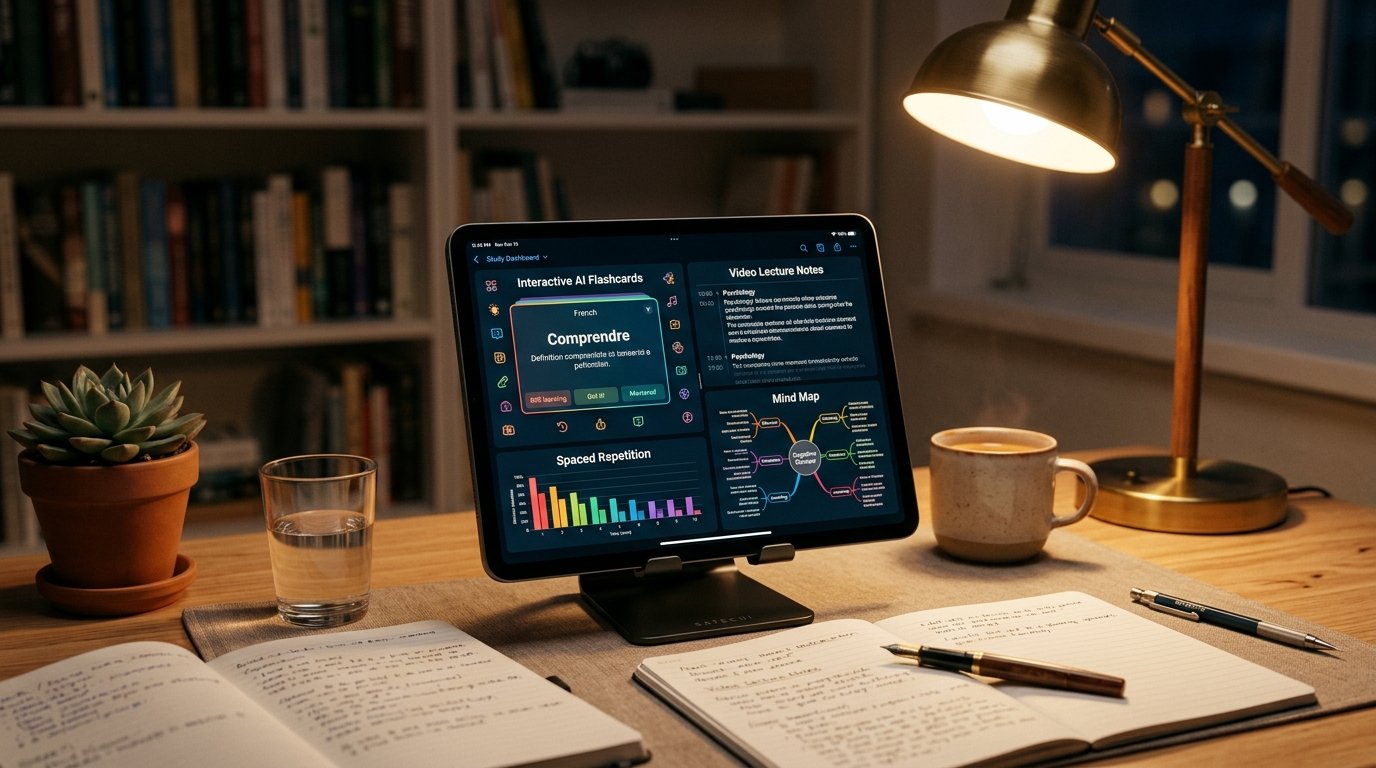
Transforming Video Lectures into Knowledge Assets: Active Recall, Spaced Repetition, and AI Study Workflows
University lectures, technical tutorials, and educational video series represent an incredible source of knowledge. However, sitting passively and watching hours of video recordings is one of the least effective ways to learn and retain complex information.
Cognitive science research demonstrates that long-term memory formation requires active cognitive effort: retrieval practice, concept mapping, and spaced repetition. In this guide, we examine evidence-based study methodologies and demonstrate how to transform passive video watching into structured knowledge assets using automated transcription and AI study frameworks.
- --
The Problem with Passive Video Watching (The Ebbinghaus Forgetting Curve)
When you watch a two-hour academic lecture without active note-taking, your brain experiences the Ebbinghaus Forgetting Curve. Within 24 hours of watching a video, the average learner forgets over 70% of the material presented unless active memory reinforcement occurs.
### Why Passive Re-Watching Fails
- **The Illusion of Competence:** Watching an expert explain a concept creates a false sense of mastery. You recognize the information while watching, but struggle to recall or apply it independently during examinations or practical projects.
- **Time Inefficiency:** Re-watching full video recordings consumes massive blocks of time without addressing specific knowledge gaps.
- --
The Science of Learning: Active Recall vs Passive Review
Two learning methodologies consistently outperform all others in cognitive psychology trials:
1. **Active Recall:** Testing your brain to retrieve information without looking at source materials (e.g., flashcard testing, practice exam questions, or teaching concepts aloud).
2. **Spaced Repetition:** Reviewing concepts at gradually increasing time intervals (e.g., Day 1, Day 3, Day 7, Day 14, Day 30) to transfer information from short-term working memory into long-term neural pathways.
- --
Step 1: Converting Lecture Audio into Searchable Transcripts
The first step in active study workflow design is extracting full spoken text from recorded lectures:
- **Instant Keyword Search:** Instead of scrolling blindly through a two-hour video timeline to find a specific formula or historical reference, searching a full transcript takes milliseconds.
- **Verbatim Accuracy:** Extracting spoken lecture text ensures technical terms, formulas, and professor emphasis are preserved accurately.
- --
Step 2: Structuring Lecture Notes Using the Cornell Method and Feynman Technique
Once a raw lecture transcript is generated using platforms like TranscriptG, apply structured note-taking frameworks:
### The Cornell Note-Taking Layout
Organize transcript notes into three distinct structural zones:
- **Cue Column (Left 25%):** Record core questions, key vocabulary terms, and topic triggers.
- **Notes Column (Right 75%):** Record detailed explanations, code snippets, and conceptual summaries.
- **Summary Block (Bottom):** Write a 2 to 3 sentence synthesis of the lecture in your own words.
### The Feynman Learning Technique
Test your conceptual mastery by explaining the topic in simple, jargon-free language as if teaching a beginner. If you hit a point of confusion, return to the lecture transcript to clarify the specific gap.
- --
Step 3: Generating Anki-Compatible Flashcard Decks from Video Text
Anki is a popular open-source spaced repetition program used heavily by medical students, software engineers, and language learners.
By feeding lecture transcript blocks into structured AI models, students can automatically convert lecture explanations into Front/Back flashcard decks:
```text
# Example Flashcard Formatting from Lecture Transcript
Q: What is the primary function of dual base ISO in digital camera sensors?
A: It provides two distinct hardware gain circuits, allowing clean low-noise signal capture at higher ISO sensitivity levels without adding digital shadow grain.
Q: What is the main difference between Active Recall and Passive Review?
A: Active recall forces the brain to retrieve information from memory without assistance, whereas passive review simply re-reads or re-watches source materials.
```
- --
Frequently Asked Questions (FAQ)
How does video transcription help students with learning disabilities?
Transcripts provide essential accessibility support for students with auditory processing differences, hearing impairments, or ADHD, allowing them to read along, search text visually, and learn at their own comfortable pace.
Can I turn an entire YouTube course playlist into a study guide?
Yes. Using TranscriptG, you can extract transcripts from each video in a playlist, synthesize key chapter summaries, and construct a complete semester study manual in minutes.
- --
Elevate your academic performance today by turning lecture videos into structured notes and study guides with TranscriptG!
Launch Free Tools