YouTube SEO Masterclass: The Definitive Guide to Ranking #1 on YouTube & Google Discover
PART 1: Magnetic Title Options for Maximum Organic CTR & Google Discover Engagement
Before diving into the algorithmic mechanics of video optimization, here are 5 high-converting, magnetic title formulas engineered to trigger immediate curiosity, satisfy Google Discover CTR thresholds, and dominate high-intent YouTube Search queries:
1. **YouTube SEO Masterclass 2026: The Secret Algorithm Blueprint to Rank #1 Fast** (Primary High-Intent Target)
2. **Why 99% of YouTube SEO Tutorials Are Dead Wrong (And the Reverse-Engineered 2026 Fix)** (High-CTR Curiosity Hook)
3. **From 0 to 1,000,000 Impressions: The Ultimate YouTube & Google Video Search Playbook** (Social Proof & Scale Hook)
4. **The Transcription Cheat-Code: How Indexing Spoken Subtitles Forces Google to Rank Your Videos** (Feature-Focused Force Multiplier)
5. **How the YouTube Neural Network Actually Ranks Videos in 2026 (Full Technical Breakdown)** (Deep Technical Authority Hook)
- --

- --
PART 2: Introduction - The Evolution of YouTube Search & Discovery
The landscape of video search engine optimization has undergone a seismic shift. A decade ago, ranking a video on YouTube was ridiculously simple: you stuffed your target keyword into the title, wrote a brief two-sentence description, spammed fifty hidden tags, and bought automated backlink packages. The search engine relied entirely on primitive, static metadata matching because computers lacked the computational processing power to understand raw video pixels and acoustic audio streams.
Today, YouTube is not merely a video hosting website; it is the second-largest search engine on Earth and the world's most sophisticated recommendation engine. Powered by Google’s deep neural networks, multimodal Gemini AI models, and Large Language Models (LLMs), YouTube no longer needs human creators to tell it what a video is about through static meta tags. The system actively "listens" to every word spoken in your video, analyzes visual frames in real-time, maps semantic relationships between spoken topics, and measures the micro-behavioral responses of millions of concurrent viewers.
Furthermore, the boundary between YouTube Search and Google Search has completely dissolved. Video carousels, Google Discover feeds, and AI Overviews (SGE) now feature YouTube video clips prominently at the very top of Google Search Engine Results Pages (SERPs). When a user searches for a solution on Google, the search engine frequently serves a timestamped YouTube video segment—a "Key Moment"—directly answering the exact query.
This evolution presents an unprecedented growth opportunity for digital marketers, business owners, and video creators. However, it also renders traditional SEO tactics completely obsolete. If you are still optimizing videos using 2018 keyword-stuffing formulas, your content is effectively invisible to the algorithm.
To win in 2026, you must master the intersection of **Semantic Natural Language Processing (NLP)**, **Neural Network Recommendation Signals**, and **Audience Retention Psychology**. This comprehensive blueprint will provide you with the exact technical frameworks, operational workflows, and execution strategies required to achieve total search dominance and capture viral Google Discover traffic.
- --
PART 3: Decoding the YouTube Algorithm - Neural Networks & Ranking Signals
To manipulate an algorithm, you must first understand its underlying mathematical objectives. YouTube’s recommendation system operates on two distinct neural network layers, originally codified in Google’s landmark research paper *"Deep Neural Networks for YouTube Recommendations"*:
1. **Candidate Generation (Nomination Layer):** The system takes millions of available videos on the platform and filters them down to a personalized candidate pool of a few hundred videos based on the user's historical watch behavior, search logs, and cohort demographics.
2. **Ranking & Scoring Layer:** The candidate videos are assigned a dynamic score based on feature vectors, expected watch duration, click-through probability, and satisfaction signals. The highest-scoring videos are presented to the user on their Homepage, Suggested Video sidebar, and Search feed.
### The Shift from Keywords to Satisfaction Signals
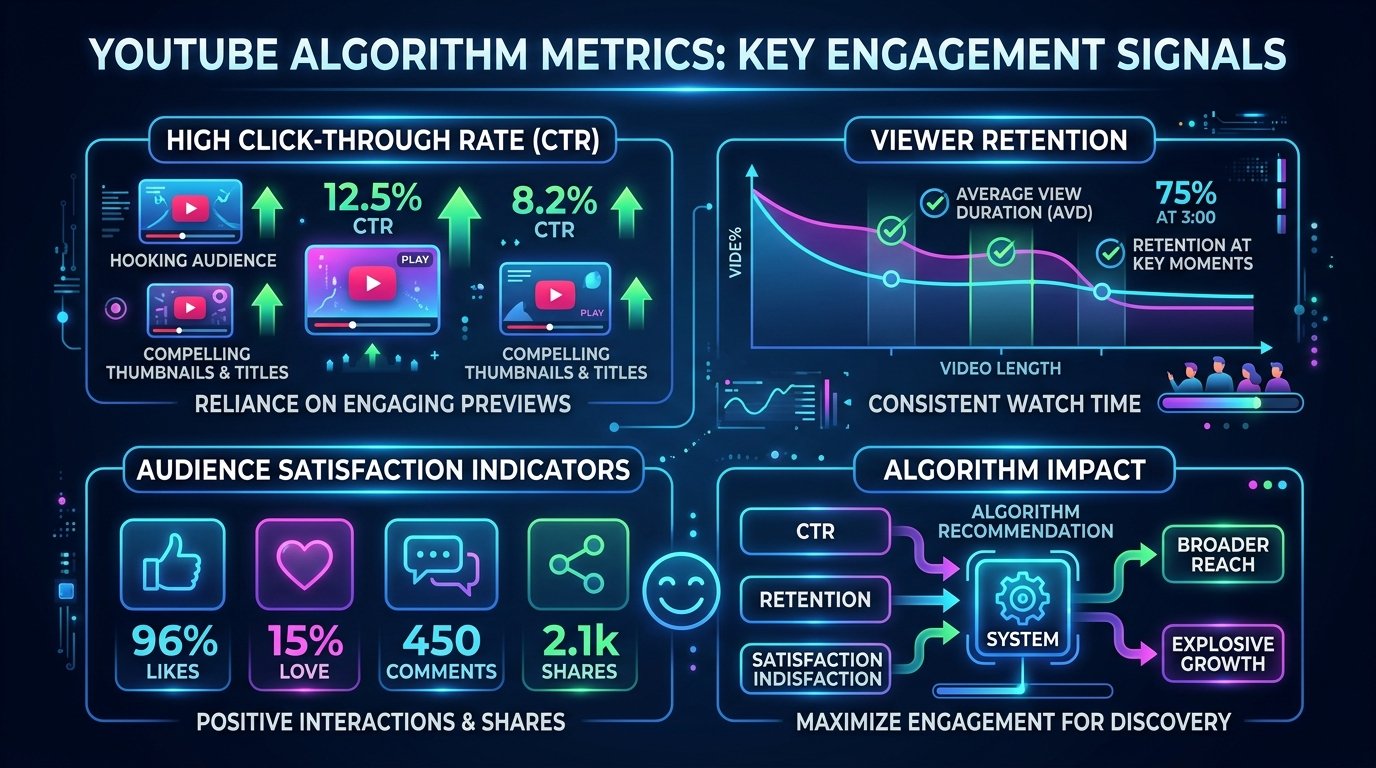
In the early days of YouTube, the primary ranking metric was **Click-Through Rate (CTR)**. This led to an epidemic of aggressive clickbait—misleading thumbnails and sensationalized titles that tricked users into clicking videos that failed to deliver value. To combat this, YouTube shifted its primary metric to **Watch Time** (total minutes accumulated). While this was an improvement, creators responded by artificially lengthening videos with boring fluff.
In the modern 2026 algorithm, YouTube optimizes for a holistic metric known as **Valued Watch Time** and **Viewer Satisfaction**. The algorithm measures not just how long a user stays on a video, but whether that view resulted in a positive, high-value experience.
### Primary vs Secondary Algorithmic Ranking Signals
To understand how YouTube prioritizes content, examine the comparative weight distribution between primary behavioral signals and traditional static metadata:
| Ranking Signal Category | Specific Signal Metric | Relative Algorithmic Weight | Operational Mechanism & Impact |
|---|---|---|---|
| :--- | :--- | :--- | :--- |
| **Tier 1: Behavioral Signals** | Average View Duration (AVD) & Retention % | **Critical (35%)** | Measures narrative pacing, audience interest, and hook efficiency. |
| **Tier 1: Behavioral Signals** | Click-Through Rate (CTR) | **Critical (25%)** | Evaluates visual thumbnail contrast, title curiosity, and feed saliency. |
| **Tier 1: Behavioral Signals** | Session Duration & Binge Loops | **High (15%)** | Measures whether a video keeps the user on YouTube or starts a watch session. |
| **Tier 2: Semantic Signals** | Spoken-Word Transcript Index (.SRT) | **High (12%)** | Parses exact phonetic audio into vector embeddings for LSI and voice search. |
| **Tier 2: Semantic Signals** | On-Page Metadata (Title & Description) | **Medium (8%)** | Guides initial candidate nomination before behavioral data is gathered. |
| **Tier 3: Engagement Signals** | Likes, Comments, Shares, Subscriptions | **Moderate (5%)** | Signals active satisfaction, community discussion, and social proof. |
- --
- --
### How YouTube Uses Vector Embeddings for Search Matching
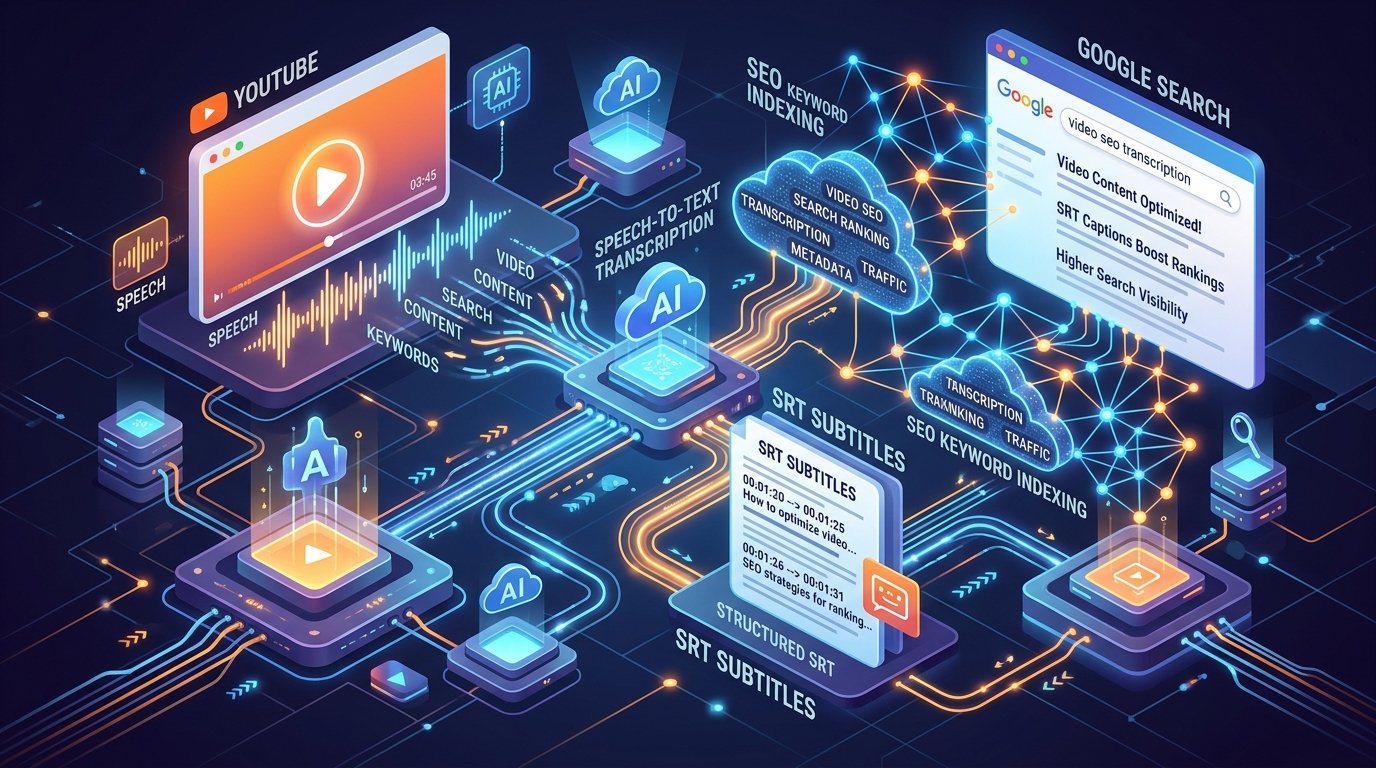
When you upload a video, YouTube's Natural Language Processing (NLP) pipeline converts the video's textual metadata and spoken audio transcript into a high-dimensional mathematical vector space.
If your video is about "YouTube SEO Strategy," the engine does not just look for the literal phrase "YouTube SEO." It maps adjacent semantic concepts—such as *"audience retention curves,"* *"click-through rate optimization,"* *"thumbnail contrast,"* and *"SRT subtitle indexing."* If these semantic vectors align closely with the search query's vector representation, your video receives a high candidate nomination score, even if the user searched for an indirect long-tail query like *"how to make YouTube videos rank higher on Google."*
- --
PART 4: Advanced YouTube Keyword Research - Uncovering High-Intent Opportunities
Keyword research for YouTube is fundamentally different from traditional Google blogging keyword research. Blog readers are often looking for quick transactional answers or textual lists. YouTube viewers, however, are seeking visual demonstrations, step-by-step tutorials, storytelling, or entertainment.
To uncover high-volume, low-competition keyword opportunities that drive sustained organic views, you must execute a multi-tier keyword research methodology.
### 1. YouTube Search Auto-Suggest Mining
The YouTube search bar is the most direct window into active user intent. When you type a query into the search box, YouTube automatically populates the dropdown with real search phrases that users are typing right now, ordered by current search velocity.
- **The Wildcard Method:** Type your core seed keyword followed by an underscore or letter (e.g., "YouTube SEO a", "YouTube SEO b", "YouTube SEO for _"). This uncovers highly specific long-tail queries.
- **The Modifier Framework:** Combine your core keyword with high-intent modifiers:
- *Tutorial Modifiers:* "how to," "step by step," "complete guide," "for beginners," "walkthrough."
- *Comparison Modifiers:* "vs," "best tool for," "review," "alternatives."
- *Problem Modifiers:* "fix," "why my video is," "not getting views," "error."
### 2. Reverse-Engineering Competitor Outlier Content
One of the fastest ways to validate keyword demand is to locate **Outlier Videos** on competitor channels in your niche.
An Outlier Video is an upload that achieves **3x to 10x higher views than the channel’s average subscriber count or baseline view performance.**
#### Step-by-Step Outlier Discovery Workflow:
1. Identify 10 to 15 channels in your exact niche ranging from 5,000 to 100,000 subscribers.
2. Navigate to their "Videos" tab and sort by "Popular."
3. Scan for recent videos (published within the last 3 to 12 months) that significantly outperform the channel’s typical upload performance.
4. Analyze the core topic, title phrasing, and thumbnail concept of that outlier. If a smaller channel with 10,000 subscribers managed to pull 250,000 views on a specific keyword topic, it proves that massive organic search demand exists for that topic, independent of channel authority.
### 3. Google SERP & Video Carousel Intent Matching
Because Google embeds YouTube videos directly on search results pages, you can double your traffic by targeting keywords that trigger **Video Carousels** or **Featured Key Moments** on Google.
Keywords that consistently trigger video results on Google include:
- Physical "How to" tutorials (e.g., "How to tie a tie," "How to replace iPhone battery")
- Software walkthroughs (e.g., "How to transcribe YouTube video to text free")
- Product reviews & head-to-head comparisons (e.g., "Sony FX3 vs FX6 review")
- Visual breakdowns & sports highlights
- --
PART 5: On-Page Video Optimization Matrix - Titles, Descriptions & Timestamps
Once you have identified your primary target keyword and secondary LSI terms, you must construct a flawless on-page optimization matrix. This ensures that when YouTube's candidate generation bot crawls your video asset, it immediately understands your content's exact context and target audience.
### 1. The High-CTR Title Engineering Blueprint
Your title is the single most important piece of text copy on your video asset. It serves two distinct masters: it must contain your primary target keyword for the indexing crawler, and it must create irresistible curiosity or value for human viewers in the feed.
#### The Golden Rules of Title Optimization:
- **Front-Load Primary Keywords:** Place your exact target keyword within the first 4 to 5 words of the title. This ensures maximum visual emphasis on mobile screens and higher weighting in crawler text parsing.
- **Respect the Mobile Cut-Off:** Keep your title length between **50 and 60 characters**. Titles longer than 60 characters are frequently truncated with ellipses (...) on mobile devices, obscuring your core message.
- **Include Bracketed Modifiers:** Adding bracketed callouts like '[Step-by-Step]', '[2026 Guide]', or '[Free Template]' can increase Click-Through Rate by up to **14% to 22%** by signaling immediate tangible value.
#### Title Formula Comparison Matrix:
| Title Architecture Type | Structural Blueprint Formula | Practical Real-World Example | Target Audience Impact |
|---|---|---|---|
| :--- | :--- | :--- | :--- |
| **High-Intent Search Title** | '[Primary Keyword]: [Specific Solution / Outcome] [Year]' | YouTube SEO Strategy: How to Rank #1 Fast [2026] | Ideal for capture of active problem-seekers in search. |
| **Curiosity-Driven Feed Title** | '[Unusual Hook / Contrast Statement] + [Primary Keyword]' | Why Your Videos Get 0 Views (Fixing Your YouTube SEO) | Triggers high CTR in Browse Features & Google Discover. |
| **Data-Backed Proof Title** | 'How I Got [X Outcome] Using [Primary Strategy]' | How I Got 500,000 Views with YouTube Subtitle SEO | Combines social proof with high actionable utility. |
- --
### 2. High-Yield Video Description Copywriting
Many creators treat the video description as an afterthought, leaving it empty or stuffing it with irrelevant affiliate links. In reality, the description box is a goldmine for semantic SEO indexation.
The description box provides search crawlers with 5,000 characters of rich context. To maximize semantic authority, structure your description using this exact four-section framework:
- -- Description Framework ---
[Section 1: The First 3 Lines (Above the Fold)]
In this complete YouTube SEO tutorial, you will learn the exact step-by-step strategy to rank your videos #1 on Google Search and YouTube in 2026. We cover advanced semantic keyword research, algorithm retention mechanics, and how to transcribe YouTube videos to text using TranscriptG.com to unlock automated subtitle indexing.
[Section 2: Deep Semantic Summary (200 - 300 Words)]
Mastering YouTube search engine optimization requires moving beyond basic tag stuffing. In this guide, we break down how Google's neural network recommendation engines evaluate Average View Duration (AVD) and Click-Through Rate (CTR). You will discover how uploading manual SubRip (.SRT) subtitle files acts as a massive ranking force multiplier by feeding clean, punctuated text directly to Google's Natural Language Processing (NLP) crawlers.
[Section 3: Interactive Timestamp Chapters]
0:00 - Introduction to YouTube SEO
1:45 - Decoding the YouTube Recommendation Algorithm
4:20 - Advanced Keyword Research Workflows
8:15 - On-Page Video Metadata Matrix
12:30 - The Subtitle & Transcription SEO Advantage (TranscriptG)
16:10 - Audience Retention & Loop Hooks
20:45 - Final Off-Page Promotion Playbook
[Section 4: Resource Hub & Author Footprint]
Tools Mentioned in This Video:
- Free YouTube Transcript Generator: https://transcriptg.com
- Authoritative SEO Guides: https://transcriptg.com/guides
- ----------------------------
- --
### 3. Video Chapters & Key Moments Optimization
Adding timestamped chapters to your description is no longer optional—it is a mandatory technical requirement for modern video SEO.
When you format timestamps correctly in your description (starting at '0:00' with at least 3 distinct timestamps of 10+ seconds each), YouTube automatically splits your video timeline into labeled visual chapters. More importantly, **Google Search uses these chapter markers to generate "Key Moments" directly on SERP pages.**
This enables your video to occupy **3x to 5x more vertical visual real estate** on Google search results pages, allowing users to jump directly to the exact second in your video that answers their query.
- --
PART 6: Transcription Power-Up - The Unfair SEO Advantage (TranscriptG.com)
If you ask top media agencies for their #1 "secret weapon" to double organic search traffic without filming additional content, the answer is always the same: **Manual Subtitle Transcription Indexing.**
- --
- --
### The Hidden Truth About YouTube’s Automatic Captions (ASR)
Most creators rely on YouTube’s default Automatic Speech Recognition (ASR) captions. They assume that because YouTube automatically generates subtitles, their video’s audio is already being indexed for search.
This is a catastrophic mistake.
While YouTube does generate automatic captions using machine learning, **Google's search crawlers penalize or ignore automatic captions for top-tier search rankings.**
#### Why Automatic Captions Fail for SEO:
1. **The Punctuation Void:** ASR systems output a continuous stream of words without periods, capital letters, or paragraph breaks. To Google’s BERT and Gemini NLP models, unpunctuated text is noisy and difficult to parse into distinct semantic concepts.
2. **The Homophone & Brand Name Error:** ASR frequently misinterprets technical terms, industry jargon, and brand names. If you say *"TranscriptG,"* automatic captions often render it as *"transcript gee"* or *"transcript key."* As a result, your primary brand and technical keywords completely vanish from the search index.
3. **No Latent Indexing Weight:** Because automatic captions are prone to spam and inaccuracy, Google assigns significantly lower algorithmic authority to videos that rely solely on default ASR tracks.
### How Manual Subtitle Uploads (.SRT) Act as a Ranking Force Multiplier
When you upload a clean, manually punctuated, and accurate SubRip (.srt) or WebVTT (.vtt) subtitle file to YouTube Studio, the search crawler treats it as an **authoritative, verified text schema document.**
#### The Immediate SEO Benefits of Manual Subtitles:
- **Exact-Match & Long-Tail Keyword Indexing:** Every single word, technical term, and long-tail phrase spoken in your video becomes 100% searchable in Google's index.
- **Global Multilingual SEO Expansion:** By translating your clean manual transcript into high-value global languages (such as Spanish, German, French, Portuguese, and Hindi), your video can rank in international search results, instantly opening up global ad pools and higher CPMs.
- **Full Compliance with Accessibility & Silent Viewing:** Over 85% of mobile video content is scrolled on mute. Subtitles keep silent viewers engaged, dramatically boosting Average View Duration (AVD).
- --
### Automatic Captions (ASR) vs TranscriptG Manual Subtitles (.SRT) Matrix
| Feature & Ranking Dimension | Default YouTube Automatic Captions (ASR) | TranscriptG Manual Subtitles (.SRT Upload) |
|---|---|---|
| :--- | :--- | :--- |
| **Search Indexing Authority** | **Low / Penalized** (High noise & error rates) | **Maximum Priority** (Clean, authoritative schema) |
| **Grammatical Punctuation** | **None** (Continuous run-on text) | **Flawless** (Full sentence structure & casing) |
| **Technical & Brand Accuracy** | **Poor** (Frequent misspellings & homophone errors) | **100% Precise** (Custom technical terms preserved) |
| **Google SERP Key Moments** | **Unreliable** (Frequent timing offsets) | **Exact Microsecond Precision** (Triggers Key Moments) |
| **Multilingual Localizing** | **Distorted** (Garbage-in, garbage-out translation) | **High-Fidelity** (Accurate cross-border SEO reach) |
| **Cost & Latency to Generate** | Free (but costs thousands in lost search views) | **100% Free at TranscriptG.com** (Instant extraction) |
- --
### How TranscriptG.com Acts as a Creator Force Multiplier
- *TranscriptG.com** is engineered specifically to eliminate the friction of video transcription and content repurposing. As a 100% free, client-side web application requiring zero sign-up or subscription fees, TranscriptG serves as the ultimate bridge between spoken video dialogue and multi-channel SEO dominance.
#### The 60-Second TranscriptG Video-to-SEO Workflow:
1. **Extract Clean Transcripts:** Paste any public YouTube video link into **TranscriptG.com**. The system instantly pulls the raw subtitle data directly into your browser sandbox, eliminating subtitle noise and restoring clean paragraph structures.
2. **Export Validated .SRT Files:** Download the clean, timestamp-synchronized .srt file with a single click and upload it directly into YouTube Studio under the "Subtitles" tab.
3. **Repurpose Video into Long-Form Blog Assets:** Use TranscriptG's integrated **AI Blog Generator** tab to convert the spoken video transcript into a fully structured, 2,000+ word Markdown blog post complete with H2/H3 headers, bulleted lists, and FAQ sections.
4. **Publish Companion Articles for Dual Ranking:** Publish the generated article on your website (e.g., WordPress, Ghost, or Webflow) and embed your YouTube video at the top of the post.
By executing this workflow, you construct a powerful **Dual-Ranking SEO Loop**: your website article ranks on Google SERPs driving traffic to your YouTube video, while your YouTube video ranks on YouTube Search driving high-intent readers back to your website!
Experience the power of 100% free, instant video transcription and content repurposing today at [TranscriptG.com](/)!
Launch Free Tools- --
PART 7: Audience Retention & Engagement Optimization - Engineering the Hook
You can possess the most flawless metadata and subtitle schema on the platform, but if viewers close your video after 10 seconds, the algorithm will rapidly bury your content.
Audience retention is the ultimate validator of content quality. The YouTube algorithm closely monitors your video's **Audience Retention Curve** inside YouTube Analytics. If your retention graph shows a steep cliff in the opening seconds, it signals to the recommendation system that your video failed to fulfill the promise made by its title and thumbnail.
### 1. Defeating the 15-Second Retention Cliff
On average, **40% to 60% of viewers drop off during the first 15 to 30 seconds of a video.** To eliminate this drop-off and stabilize your retention baseline, you must eliminate slow, self-indulgent intros.
#### What to BAN in Your First 30 Seconds:
- ❌ Animated channel intro logos or spinning 3D text
- ❌ Prolonged personal greetings ("Hey guys, welcome back to my channel!")
- ❌ Asking viewers to like and subscribe before providing any value
- ❌ Wasting time explaining who you are or what your channel does
- --
### The PPP (Problem, Proof, Promise) Hook Framework
To lock viewers in immediately, structure your opening 30 seconds using the battle-tested **PPP Hook Framework**:
1. **The Problem (0:00 - 0:10):** Agitate the viewer’s core pain point or state a high-stakes challenge visually and verbally.
- *Example:* "If your YouTube videos are stuck at 200 views, it's not because the algorithm hates you—it's because your videos are completely invisible to Google's search crawlers."
2. **The Proof (0:10 - 0:20):** Demonstrate immediate authority or show proof that you have solved this exact problem.
- *Example:* "In this masterclass, I'm showing you the exact transcript indexing strategy we used to scale from zero to over 1,000,000 organic search impressions."
3. **The Promise (0:20 - 0:30):** Deliver an irresistible reason to watch until the very end of the video.
- *Example:* "By the end of this guide, you will have a complete 5-step checklist to audit your own channel and rank #1 on both YouTube and Google SERPs."
- --
### 2. Strategic Pattern Interrupts & Visual B-Roll Pacing
Once your hook is established, you must maintain visual momentum throughout the body of your video. The human brain quickly becomes accustomed to static visual inputs. If you leave a camera on a static talking-head shot for longer than 6 to 8 seconds, the viewer's focus wanders, leading to drop-off.
To prevent visual boredom, incorporate **Pattern Interrupts** every 5 to 10 seconds:
- **Camera Angle Shifts:** Alternate between wide shots, tight zooms, and dynamic camera angles.
- **On-Screen Text & Graphics:** Highlight key takeaways with bold, high-contrast text overlays and vector icons.
- **Contextual B-Roll Footage:** Overlay relevant screen recordings, product shots, or stock video clips to visually demonstrate what you are speaking about.
- **Auditory Sound Design:** Utilize subtle swooshes, pop effects, and background music key-changes to signal transitions between core concepts.
- --
### 3. Engineering End-Screen Binge Loops
The ultimate signal of viewer satisfaction is a **Binge Session**. When a viewer finishes watching your video and immediately clicks onto another video on your channel, YouTube rewards your channel with a massive boost in recommendation authority.
To convert single views into multi-video binge sessions:
- **Avoid "Conclusion Signaling":** Never say "In conclusion," "To wrap things up," or "Thank you for watching." The instant viewers hear these phrases, their brain registers that the value has ended, and they swipe away before clicking your end screen!
- **Execute the Seamless Bridge Transition:** In the final 15 seconds of your video, transition directly into a related problem that is solved by another video on your channel.
- *Example:* "Now that you know how to optimize your video titles and subtitles, there is one critical mistake you must avoid when designing your thumbnails. Click the video on screen right now to learn the exact thumbnail contrast formula..."
- --
PART 8: Channel-Level SEO Authority - Optimizing Channel Architecture
Individual video optimization is only one piece of the puzzle. YouTube also assigns an overarching **Channel-Level Authority Score** based on topic consistency, channel metadata, playlist structures, and audience trust.
If your channel establishes deep topical authority in a specific niche (e.g., "AI Tools & Productivity"), every new video you publish on that topic receives a higher baseline recommendation boost than a video published by a generic, unfocused channel.
### 1. Channel Keyword Mapping
Navigate to YouTube Studio -> Settings -> Channel -> Basic Info and populate your **Channel Keywords** field.
Your channel keywords should include:
- Your primary brand name (e.g., "TranscriptG," "Akash Singh Solanki")
- 3 to 5 core high-level topic terms (e.g., "YouTube SEO," "Video Transcription," "Content Repurposing," "AI Tools")
- Common phonetic misspellings of your brand or primary keywords
### 2. Strategic Playlist Silos & Binge Architectures
Playlists are one of the most underutilized SEO assets on YouTube. When a user watches a video inside a playlist, YouTube automatically queues the next video in the playlist, triggering automated binge sessions.
#### How to Structure SEO-Optimized Playlists:
- **Target High-Intent Search Clusters:** Name your playlists using exact-match search terms (e.g., "YouTube SEO Masterclass Series" or "AI YouTube Growth Tutorials").
- **Write Rich Playlist Descriptions:** Add 150+ words of detailed description copy to every playlist, incorporating relevant LSI keywords.
- **Set Official Series Playlists:** Inside YouTube Studio, mark your primary playlists as **Official Series Playlists**. This tells YouTube that these videos belong together in a sequential order, increasing the likelihood that YouTube will recommend Episode 2 in the sidebar while a user is watching Episode 1!
- --
### 3. Channel Layout & Customization Architecture
When a viewer lands on your channel homepage, your visual branding and layout dictate whether they click "Subscribe" or leave.
#### The High-Converting Channel Layout Blueprint:
- **The Channel Trailer / Featured Video:** Set your highest-performing, highest-converting video as the Channel Trailer for non-subscribers.
- **Organized Horizontal Sections:** Structure your homepage into logical horizontal sections (e.g., "Start Here," "YouTube SEO Tutorials," "AI Repurposing Workflows," "Popular Uploads").
- **Consistent Visual Identity:** Ensure your Channel Banner (2560x1440 with a 1546x423 Safe Area) and Channel Logo are visually unified, displaying a clear, punchy value proposition.
- --
PART 9: Off-Page YouTube SEO & Promotion Strategy - Driving External Signals
While on-page metadata and retention mechanics form the core of YouTube SEO, **Off-Page Signals**—such as external embeds, social media shares, and referral traffic—provide the initial spark required to trigger algorithmic promotion.
When a newly published video receives a sudden spike in high-quality external traffic within its first 24 to 48 hours, YouTube flags the video as a high-velocity asset and begins testing it in wider Browse and Suggested feeds.
### 1. The Omnichannel Article Embedding Strategy
The single most effective off-page SEO tactic is embedding your YouTube video inside high-authority, relevant blog posts and web pages.
#### Why External Embeds Boost YouTube Rankings:
- **High-Intent Dwell Time:** When readers watch your embedded video on an external website, YouTube registers those views as high-value, high-retention sessions.
- **Backlink & Referral Authority:** External embeds build powerful contextual backlinks, signaling to Google Search that your video asset is an authoritative resource cited across the web.
#### Execution Workflow with TranscriptG:
1. Extract the transcript of your YouTube video using [TranscriptG.com](/).
2. Convert the transcript into a 2,000+ word deep-dive article using the **AI Blog Generator**.
3. Publish the article on your website or Medium domain.
4. Embed your YouTube video at the very top of the article.
5. Add custom VideoObject JSON-LD schema markup to the web page to force Google Search to recognize the relationship between the article and the embedded video.
- --
### 2. Social Media Atomization & Teaser Clips
Do not simply post a raw link to your YouTube video on Twitter, LinkedIn, or Facebook. Social media algorithms penalize posts that contain external links because they drive users off their platforms.
Instead, execute a **Native Content Atomization Strategy**:
- **Extract Micro-Clips:** Cut 30 to 60-second high-value teaser clips from your master video.
- **Add Vertical Subtitles:** Use TranscriptG to generate subtitle scripts, and overlay bold, animated captions onto your vertical video clips.
- **Publish Natively:** Upload the teaser clip natively to Twitter/X, LinkedIn, TikTok, and Instagram Reels.
- **Drop Link in Comments:** Place the link to your full YouTube video in the first comment or bio link, keeping your main social post 100% native and algorithmic-friendly!
- --
PART 10: Future-Proofing - AI, Voice Search, and Semantic Video SEO
As we look ahead, video search is evolving beyond traditional desktop text queries. The rapid rise of AI search assistants, voice search devices (Google Assistant, Siri, Alexa), and multimodal Gemini models is fundamentally changing how users discover video content.
### 1. Optimizing for Voice Search & Conversational Queries
Voice search queries are significantly longer, more conversational, and phrased as complete questions compared to typed text queries.
- *Typed Query:* "YouTube SEO tools"
- *Voice Search Query:* "Hey Google, what is the best free website to transcribe YouTube videos to text for SEO?"
#### How to Optimize for Voice Search:
- **Incorporate Natural Question-and-Answer Pairs:** Speak explicit questions and direct answers verbatim in your video audio. (e.g., *"If you are wondering how to get a transcript from a YouTube video for free, the answer is to use TranscriptG.com..."*).
- **Upload Clean Manual Subtitles:** Because voice search crawlers match spoken audio streams directly with spoken user queries, having clean, punctuated .SRT files uploaded via **TranscriptG** is the single most effective way to rank for voice search results.
- --
### 2. Multimodal AI Indexing & Generative SERPs (SGE)
Modern AI models like Gemini 2.5 do not just read text—they analyze video frames, recognize physical objects, read on-screen text overlays, and synthesize audio concepts simultaneously.
In Google’s AI-powered search overviews, AI models generate dynamic video summaries and direct clip recommendations based on the deep semantic understanding of your content.
#### How to Future-Proof Your Content for AI Crawlers:
1. **Speak Keywords Clearly and Early:** Clearly articulate your primary concepts and keywords in your vocal audio track during the first 60 seconds.
2. **Use High-Contrast On-Screen Text:** Display your core topics and chapter headers as clear text overlays on screen. AI vision models read this text to verify topic accuracy.
3. **Maintain a Unified Multi-Asset Footprint:** Ensure your video, transcript, companion blog post, and social media threads share consistent semantic naming and schema structures.
- --
Final Checklist: The Ultimate YouTube SEO Masterclass Execution Plan
To guarantee that every video you publish achieves maximum organic search visibility and captures high-engagement Google Discover traffic, execute this final pre-publish checklist:
- [ ] **Keyword Validated:** Mined high-intent long-tail keywords using YouTube Auto-Suggest and Google SERP Video Carousels.
- [ ] **Outlier Concept Verified:** Confirmed topic demand by analyzing competitor outlier videos.
- [ ] **PPP Hook Executed:** Structured the first 30 seconds with a Problem, Proof, and Promise hook to eliminate drop-off.
- [ ] **Front-Loaded Title:** Placed primary keyword within the first 5 words of a 50-60 character title. Included bracketed callouts.
- [ ] **Deep Semantic Description:** Written a 200+ word description containing primary and secondary LSI keywords.
- [ ] **Timestamp Chapters Added:** Formatted interactive chapter timestamps starting at '0:00' to trigger Google SERP Key Moments.
- [ ] **Clean .SRT Subtitles Uploaded:** Extracted clean, punctuated subtitles using **TranscriptG.com** and uploaded the manual .srt file.
- [ ] **Dual-Ranking Blog Article Published:** Converted transcript into a companion website article with embedded video.
- [ ] **High-Contrast Thumbnail Designed:** Created a 1280x720 thumbnail with complementary color contrast, expressive faces, and <3 words of text.
- [ ] **End-Screen Binge Loop Configured:** Linked to a related video inside an official Series Playlist without signaling a verbal conclusion.
By systematically applying these advanced SEO frameworks, leveraging **TranscriptG.com** as your transcription and repurposing engine, and prioritizing viewer satisfaction, you possess the ultimate competitive advantage to dominate YouTube Search, command Google SERPs, and scale your digital brand in 2026 and beyond!
- --
Ready to supercharge your YouTube SEO and turn video transcripts into viral articles, social threads, and study guides? Launch [TranscriptG's Free AI Toolkit](/) now!
Launch Free Tools